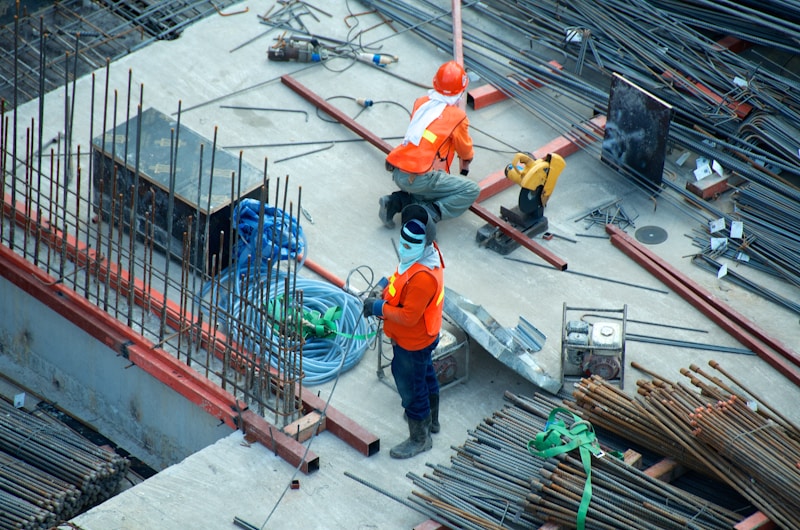
Iron rod is the material that does the quiet, structural work in a Nigerian house — and lately it has been the one making the loudest noise in the budget. In our roundup for September 6–12 we reported that the price of a 12mm rod had climbed from about ₦8,000 to as much as ₦19,000 within a year. When a line item more than doubles, getting the quantity right stops being a technical nicety and becomes a real saving: overbuy by 15% and you have paid for iron you will never use; underbuy and work stops while you chase a supplier at today's price.
This guide explains how much reinforcement goes into each part of a house. We cover bar sizes and weights, the kilograms-per-cubic-metre rules of thumb, three worked examples with naira costs, and how to convert weight into bars to order. One caution up front: rules of thumb are for early budgeting. The structural engineer's drawings and bar bending schedule are always the authority.
Bar Sizes and What They Weigh
Reinforcement bars are named by diameter in millimetres — Y8, Y10, Y12, Y16, Y20 and so on, where "Y" denotes high-yield deformed steel. The weight of a bar per metre depends on its diameter squared, which is why the weight climbs so quickly as the bars get thicker. The standard values are:
| Bar | Weight per metre | Weight of a 12m bar | Typical use |
|---|---|---|---|
| Y8 | 0.395 kg | 4.74 kg | Stirrups, links, light slab distribution |
| Y10 | 0.617 kg | 7.40 kg | Slab distribution bars, stirrups in beams |
| Y12 | 0.888 kg | 10.66 kg | Column main bars, slab main bars, small beams |
| Y16 | 1.579 kg | 18.95 kg | Beam main bars, heavily loaded columns |
| Y20 | 2.467 kg | 29.60 kg | Large beams, transfer elements, multi-storey columns |
Two practical points follow. First, price by weight, not by bar count. A quote of "₦19,000 per bar" means nothing until you know the bar length — 12m is common, but check what your supplier actually sells — and the diameter. Second, our BOQ library prices high-tensile Y12 reinforcement at about ₦1,600 per kg and Y16 at about ₦1,700 per kg. On that basis a 12m Y12 bar (10.66 kg) works out at roughly ₦17,000, which is in line with the ₦19,000 upper figure reported in the market.
Rules of Thumb: Kilograms of Steel per Cubic Metre of Concrete
Before drawings exist, estimators use "steel intensity" — the kilograms of reinforcement per cubic metre of concrete — for each element. Published ranges differ a little between sources, which is itself a reminder that these are rough guides:
| Element | Typical range (kg per m³ of concrete) |
|---|---|
| Foundation footings / pads | 70–80 |
| Slabs | 80–100 |
| Beams | 110–125 |
| Columns | 100–160 (depends heavily on section size and load) |
Ranges above are drawn from published estimating guides such as SteelonCall's thumb-rule guide, which puts slabs at 80–100, beams at 110–125, columns at 100–120 and footings at 70–80 kg/m³; other sources give higher figures for columns, up to about 160 kg/m³. The same guide adds a second useful shortcut — steel in a slab is roughly 1% of the concrete volume — and one important caveat: actual site consumption usually exceeds the estimate by 2–5% because of laps, anchorage, cutting waste and congestion at junctions. For whole buildings, an average of roughly 4.5–5.5 kg per square foot of built-up area (about 48–59 kg per m²) is quoted for framed reinforced-concrete residential buildings. Treat that as an upper reference: single-storey blockwork houses, where the walls carry much of the load, usually need less reinforcement than a framed structure, so your engineer's schedule should be the check.
Three Worked Examples
The quickest way to see how the numbers behave is to build them up from bar lengths, the same way our Rebar Calculator does. All costs below use ₦1,600/kg (Y8, Y10, Y12) and ₦1,700/kg (Y16), which are indicative planning rates — replace them with your supplier's quote.
Example 1: A 225 × 225mm Column, 3m High
Four Y12 main bars and Y8 stirrups at 200mm centres.
- Main bars: 4 bars × 3.0m × 1.04 (lap allowance) = 12.48m × 0.888 kg/m = 11.08 kg
- Stirrups: 3.0m ÷ 0.2m + 1 = 16 stirrups, each about 1.2m (perimeter plus hooks) = 19.2m × 0.395 kg/m = 7.58 kg
- Total: 18.7 kg per column, about ₦29,900
The column holds 0.225 × 0.225 × 3.0 = 0.152 m³ of concrete, so the steel intensity is about 123 kg/m³ — comfortably inside the rule-of-thumb range. Ten such columns need about 187 kg, roughly ₦299,000 of steel.
Example 2: A 225 × 450mm Beam, 5m Span
Three Y16 bars at the bottom, two Y12 at the top, Y8 stirrups at 200mm, and 600mm anchorage at each end.
- Bottom bars: 3 × (5.0 + 1.2) = 18.6m × 1.579 = 29.4 kg
- Top bars: 2 × 6.2 = 12.4m × 0.888 = 11.0 kg
- Stirrups: 26 stirrups × 1.65m = 42.9m × 0.395 = 17.0 kg
- Total: 57.3 kg, about ₦94,700
The concrete volume is 0.506 m³, giving roughly 113 kg/m³ — again inside the published range for beams.
Example 3: A 5 × 4m Slab, 150mm Thick
Y12 main bars at 200mm centres and Y10 distribution bars at 250mm, single layer.
- Main bars: 21 bars × 5.0m = 105m × 0.888 = 93.2 kg
- Distribution bars: 21 bars × 4.0m = 84m × 0.617 = 51.8 kg
- Total: 145 kg, about ₦232,000
The slab holds 3.0 m³ of concrete, so the intensity is only about 48 kg/m³ — well below the 80–100 kg/m³ rule of thumb. That gap is instructive. A single-layer mat calculation counts only the basic grid; real slabs also carry top steel over supports, extra bars at openings, bent-up bars, laps and edge details, which is why the thumb rule is higher. It is the clearest illustration of why you should never rely on one method alone: use the bar-length build-up to sanity-check the rule of thumb, and the engineer's bar schedule to decide.
From Kilograms to Bars to Order
Once you know the weight you need in each diameter, convert it to bars: divide the total kilograms by the weight of one bar of your supplier's standard length. For the ten columns above, the 110.8 kg of Y12 main bars is about 10.4 bars of 12m by weight — but the columns need 40 separate pieces of 3.12m, and only three fit in a 12m bar, so you would actually order 14 bars unless the offcuts are used elsewhere. The Y8 stirrup steel is bought in Y8 bars and cut and bent on site. In practice:
- Plan cutting so offcuts are used. A 12m bar cut into 3.12m column lengths yields three pieces and wastes 2.64m; cutting 4m or 6m lengths against your schedule can save material. Ask your bar bender to build the cutting list, not just the total.
- Add an allowance. Add 5–10% for cuts, laps and losses on top of the calculated quantity, and treat 2–5% as the bare minimum overrun even on a well-run site.
- Order by diameter and in stages. Foundations first, then columns, then beams and slabs. Ordering everything at once ties up cash and invites theft or rust.
Common Reinforcement Mistakes
- Buying "by the bundle" without checking weight. Bars sold as "12mm" can fall short of the nominal size. Weigh a sample and check that the marked size and the weight per metre agree.
- Cutting the cover. Concrete cover protects steel from corrosion. Spacers or cover blocks are a cheap way to keep bars where the drawings put them.
- Substituting sizes without asking. Swapping Y16 bars for more Y12 bars because they are "the same weight" changes how the member behaves. Only the engineer can approve substitutions.
- Ignoring laps. Splices need overlap lengths measured in bar diameters; short laps are a structural defect, not a saving.
- Estimating from area alone. A quick kg-per-m² number is fine for a first budget, but a two-storey house with a heavy first-floor slab and long-span beams will not follow a single-storey average.
Keeping the Rebar Line Honest in Your BOQ
Because iron rod prices move faster than almost anything else, the rebar line deserves special treatment in your Bill of Quantities. List reinforcement in kilograms by diameter rather than as a lump sum, and state the price basis and the date of the rates. Refresh it before you commit. If you already have a BOQ from your quantity surveyor, upload it to our BOQ Import tool: lines it cannot price automatically can be priced with a built-in calculator, including the Rebar Calculator, and you can review and edit every rate before export. To see how a rate is built up from first principles, our Rate Analysis Tool guide walks through it.
Frequently Asked Questions
How much iron rod do I need for a 3-bedroom bungalow?
It depends on the design, the number of columns and beams, and whether the roof is a concrete slab or a timber structure with a ring beam. For budgeting, work element by element with the rules of thumb above, then replace the estimate with the quantities in your engineer's bar bending schedule. Whole-building averages quoted for framed reinforced-concrete houses are an upper reference, not a target for a blockwork bungalow.
How many kilograms are in a 12m Y12 iron rod?
About 10.66 kg, because a Y12 bar weighs 0.888 kg per metre. A Y16 bar of the same length weighs about 18.95 kg and a Y10 bar about 7.4 kg.
Is it better to buy iron rod by the ton or by the piece?
By weight gives the clearest comparison between suppliers, and larger tonnages usually attract a lower price per kg. Whatever the unit, confirm the bar length, the diameter and the grade, and get the price in writing with a validity period, because rates have been moving quickly.
What is the difference between Y-bars and mild steel (R) bars?
Y bars are high-yield deformed bars with ribs that grip the concrete, and are used for main reinforcement in modern structural design. Plain round mild steel bars are weaker and smoother, and are now mostly limited to light stirrups or specific details when the drawings call for them. Never swap one for the other without the engineer's approval.
Why does my quantity surveyor's steel figure differ from my rule-of-thumb estimate?
The QS works from the bar schedule, which counts every bar, lap and hook. Rules of thumb average many buildings and can be 20% or more away from a specific design, particularly for slabs and heavily loaded beams. Trust the schedule, and use the thumb rule only to spot a number that looks wildly wrong.
How much extra should I order for waste?
Plan for 5–10% above the calculated quantity to cover cuts, laps and losses. Good bar-bending practice can bring waste towards the lower end; poor cutting or repeated design changes push it higher. Whatever you do, treat left-over steel as an asset — record it and use it on the next stage instead of leaving it to rust on site.
Work Out Your Own Rebar Weight
Enter your column, beam, slab or pad dimensions in the free Rebar Calculator to get the bar lengths and weight, then multiply by today's price per kg. Need steel sections rather than reinforcement? Try the Steel Calculator. Building the whole house? The Professional Estimator includes reinforcement in every structural element.
Open the Rebar Calculator →