Nobody gets excited pricing a bucket. Cement, blocks, roofing sheets, tiles — those feel like "real" building costs worth researching and comparing. Wheelbarrows, head pans and buckets feel almost too mundane to budget for explicitly, which is exactly why they are the most commonly forgotten line item in informal Nigerian building estimates, even though a working site cannot function without a real supply of them.
What Each Item Actually Does
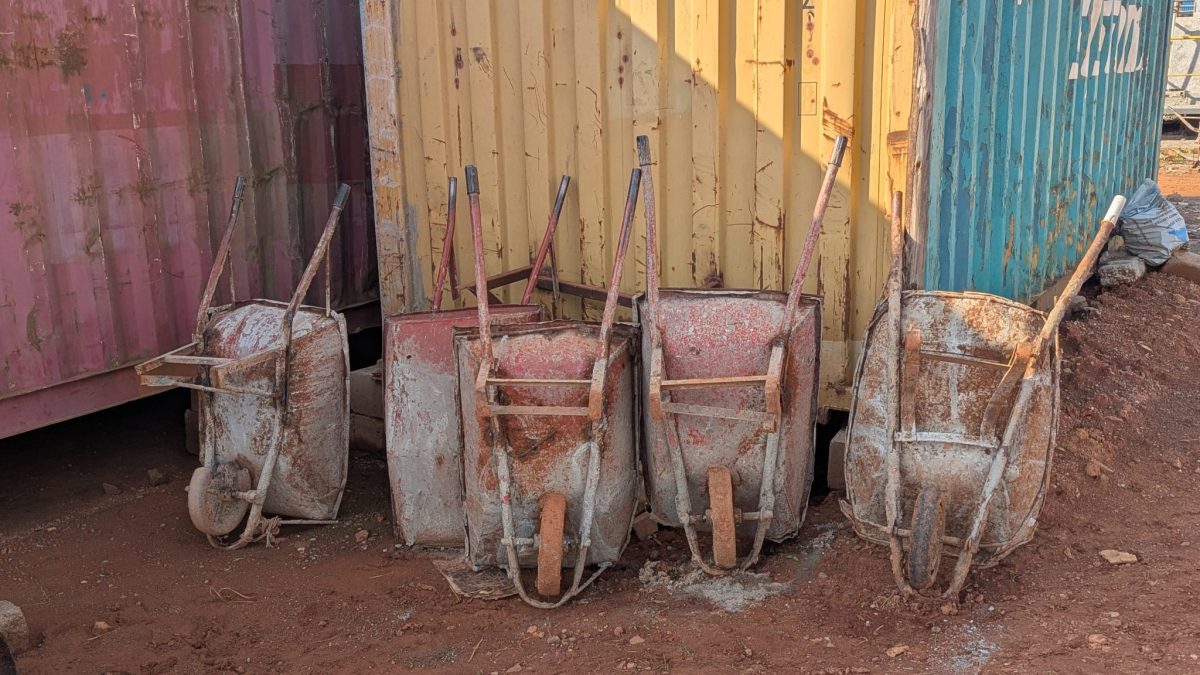
A wheelbarrow (around ₦47,000 each) moves mixed concrete, sand, and blocks across distances a head pan cannot cover efficiently — every site doing any real volume of concrete work needs at least one, and most benefit from two or more if multiple areas are being worked simultaneously.
Head pans (around ₦8,500 each) are for shorter, more frequent transport — carrying mixed mortar to a mason mid-wall, moving water, or handling anything a wheelbarrow cannot reach because of terrain or stairs. A site typically needs several at once, since multiple labourers are usually moving material simultaneously rather than sharing one pan in sequence.
Buckets (around ₦5,500 each) get used constantly and for almost everything — measuring mixing ratios, carrying water, general cleanup. It is genuinely hard to have too few tasks for a bucket on an active site, which is exactly why sites tend to need more of them than anyone initially budgets.
Shovels (around ₦13,000 each) are needed anywhere digging, mixing, or moving loose material happens — foundation excavation, concrete mixing, backfilling.
Why This Gets Skipped
Unlike cement or blocks, these items rarely appear as their own supplier invoice — they get bought informally, sometimes by the contractor without a separate line item, sometimes assumed to already exist on site from a previous job. That informality is exactly why they vanish from written budgets even though real money gets spent on them.
What a Real Site Actually Needs
For a modest self-build with a small crew, a realistic minimum is 2 wheelbarrows, 6 head pans, 8 buckets, and 4 shovels — coming to roughly ₦190,000 at the rates above. Larger sites with more simultaneous work areas need proportionally more. This is not a huge number relative to total project cost, but it is a real one, and it is precisely the kind of cost that gets absorbed into a vague "contingency" line rather than being named and planned for.
Where This Shows Up in a Proper Estimate
Our own Estimator prices this explicitly under "Miscellaneous & Site" using the same baseline rates listed above, specifically so it does not disappear into an unnamed allowance. If a contractor's quote you are reviewing has no equivalent line at all, it is worth asking directly whether it has been forgotten or simply not itemised — either way, you deserve to see the number, not just trust that it is "included somewhere."
The Practical Takeaway
None of these items individually look expensive enough to research carefully. Collectively, across a real site running for months, they represent a genuine six-figure naira cost that is worth naming explicitly in your budget from the very first draft — not discovered gradually as your labourers keep asking for "just one more bucket."
How Quantities Actually Scale With Site Size
A common question is how many of each item a specific project actually needs, since "enough" varies a lot with site size and crew count. As a rough guide: a small single-storey bungalow build with 2-3 labourers typically needs 1-2 wheelbarrows, 4-6 head pans, 6-8 buckets, and 2-3 shovels. A larger duplex or multi-unit build with 4-6 labourers working across more simultaneous areas often needs 3-4 wheelbarrows, 10-15 head pans, 12-15 buckets, and 5-6 shovels, since more concurrent work areas each need their own supply rather than sharing a single set moving between them.
Durability and Replacement Costs
These items are not one-time purchases that last the whole project untouched — a wheelbarrow tyre can puncture on rough, debris-strewn ground, head pans dent and eventually develop holes under daily abuse, and buckets crack, especially cheap ones left in direct sun for months. Budgeting a small replacement allowance — an extra 10-15% on top of the initial purchase quantity — is realistic for any project running more than a few months, rather than assuming the original purchase covers the whole build without any attrition.
Quality Tiers Worth Knowing
Wheelbarrows vary meaningfully in build quality — a reinforced steel tray with a pneumatic tyre handles rough site conditions far better than a thin-gauge budget model, and the price difference (often just ₦5,000-₦10,000 more) is worth paying given how central this single tool is to daily material movement. Head pans and buckets have far more forgiving quality tolerances for a self-build's timeline — the cheapest reasonable option is usually fine, since even a shorter lifespan still comfortably outlasts most residential build durations.
Do Not Let the Contractor Assume Silently
Because these items are so rarely itemised on a formal quote, it is easy for both sides to silently assume the other is supplying them. Raise it explicitly in your initial conversation with any contractor: "are wheelbarrows, head pans and buckets included in your quote, or should I budget for them separately?" A specific question here, asked once at the start, prevents a far more awkward conversation three weeks into the build when work is paused because nobody actually bought a wheelbarrow.
Where to Buy These Items Sensibly
Unlike power tools, where brand and specification genuinely matter, wheelbarrows, head pans, shovels and buckets have relatively little meaningful variation across sellers beyond basic build quality and price — this makes them reasonable to source from whichever local hardware supplier or general marketplace offers the most convenient price and delivery, without the same level of brand research warranted for power tools. The one exception, as noted above, is wheelbarrow tray and tyre quality, which is worth a slightly closer look given how central this one item is to daily site operations.
End-of-Project Disposal or Resale
At project completion, this equipment still has genuine residual value — a wheelbarrow, shovels, and buckets in reasonable condition can be sold on to another self-builder or a smaller contractor, recovering a portion of the original cost, or simply kept for the inevitable ongoing home maintenance tasks (gardening, minor repairs) that continue well after the main build finishes. Very few Nigerian self-builders actually need to think about disposal, since demand for secondhand basic site equipment remains steady given how many smaller projects are constantly starting up.
A Note on Labour Efficiency
Beyond simply having "enough" of each item, having the right ratio of equipment to labourers meaningfully affects how efficiently work actually proceeds. A labourer standing idle waiting for a shared wheelbarrow to free up is a real, if invisible, labour cost — effectively paying a day rate for partial productivity. If you are managing labour costs closely, treating equipment ratios (roughly one wheelbarrow per two labourers doing material-moving work, as a rough guide) as a labour-efficiency lever, not just an equipment cost, is a useful way to think about it.
Final Thought
The items covered in this post will never be the most interesting line in your budget, but they are among the most certain to actually get spent — every real site needs them, in real quantities, for the full duration of the project. Naming that cost explicitly from day one, rather than letting it accumulate invisibly through informal purchases, is a small discipline that makes your overall budget meaningfully more accurate.
See Every Line Item, Site Equipment Included
The free Estimator has a dedicated Miscellaneous & Site section for exactly this, and our Building Tools Store stocks the essentials.
Start Your Free Estimate →