Scaffolding choice on a Nigerian site is genuinely a safety decision dressed as a cost decision — the three main types available carry real differences in structural predictability, erection speed and cost that should all factor into the choice, not cost alone. This guide compares them directly using the pricing behind our free Scaffolding Calculator.
Bamboo Scaffolding
Bamboo remains a genuinely common scaffolding material on many Nigerian sites, valued for its low cost, local availability, and lightness, which makes it easy to transport and erect without heavy equipment. Its structural properties, however, are naturally variable — bamboo poles differ in strength depending on species, age, moisture content and how they were seasoned, unlike manufactured steel tube with consistent, certified specifications. This makes the erecting crew's experience and judgement disproportionately important with bamboo compared with steel systems, since a skilled crew can compensate for material variability through careful selection and lashing technique, while an inexperienced crew cannot reliably do so.
Tube and Coupler (Pipe) Scaffolding
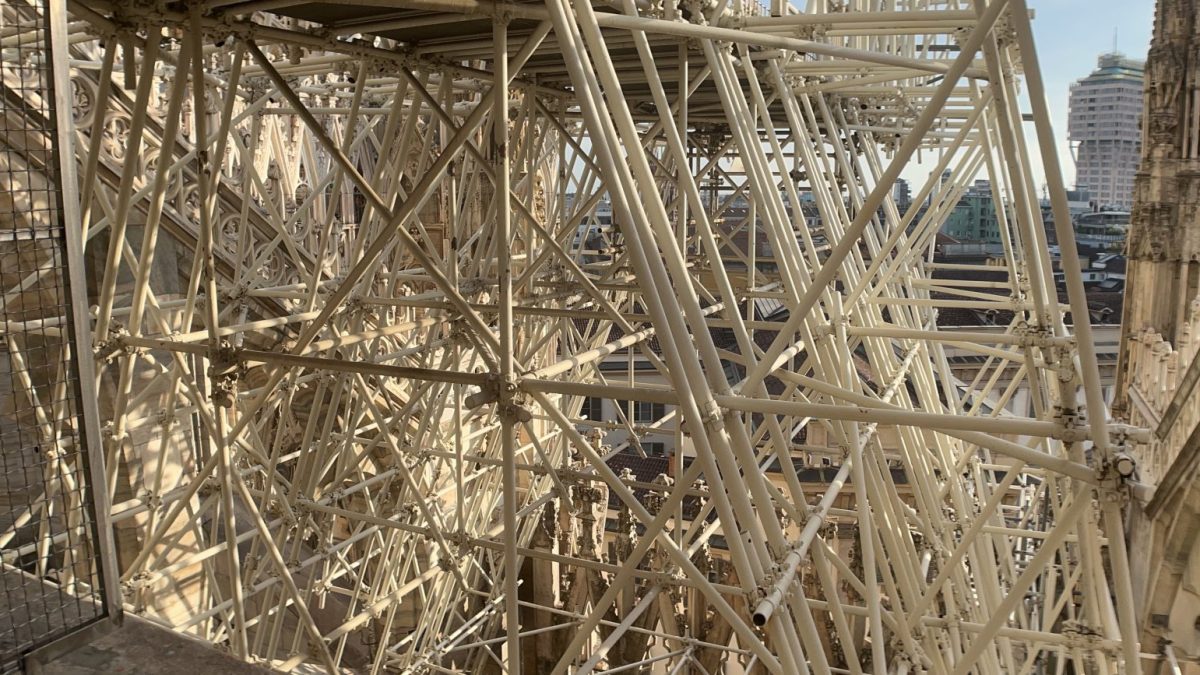
Steel tube and coupler scaffolding offers consistent, known structural properties and can be configured flexibly to almost any building shape, including awkward corners, overhangs and irregular facades that a fixed-frame system might struggle to accommodate. It requires more assembly time than a pre-engineered frame system, since each joint (coupler) is individually fitted and tightened, but this flexibility makes it the most widely used general-purpose scaffolding type across Nigerian construction.
System (Frame) Scaffolding
Proprietary frame scaffolding systems use standardised, pre-engineered components that lock or click together, dramatically speeding up erection and dismantling compared with tube and coupler, at the cost of some flexibility for unusual building shapes. The higher hire rate is often offset, particularly on larger or more standardised jobs, by significantly lower erection labour cost — the speed advantage compounds as scaffold area increases, making system scaffolding increasingly attractive for larger commercial projects even though its per-square-metre hire rate looks higher on paper.
Safety Comparison
| Type | Structural consistency | Key safety dependency |
|---|---|---|
| Bamboo | Variable, material-dependent | Heavily dependent on erecting crew's experience and material selection |
| Tube and coupler | Consistent, certified steel components | Dependent on correct coupler tightening and adequate bracing at every joint |
| System frame | Highest — engineered, standardised connections | Dependent on using matched, undamaged components from the same system |
Across all three types, the single most important safety factor remains the same: a competent, experienced erection crew following correct practice, combined with proper safety equipment (harnesses) and regular inspection throughout the period the scaffold remains in use — no scaffolding type is inherently safe if erected carelessly or left uninspected over an extended job.
Cost and Application Matrix
| Application | Recommended type | Why |
|---|---|---|
| Simple, short-duration facade work | Bamboo (with experienced crew) or tube and coupler | Lower cost for a job that does not need extended structural certainty |
| Complex, irregular building shape | Tube and coupler | Flexibility to configure around awkward geometry |
| Large-scale commercial project, standardised elevations | System frame | Erection speed savings compound over a larger scaffold area |
| Long-duration project (many weeks/months) | Tube and coupler or system frame | Greater structural predictability over an extended period of use and weather exposure |
Common Mistakes
- Choosing bamboo purely on cost for a large or long-duration job. The cost savings can be real, but the structural variability risk compounds over a longer duration and larger scale of use.
- Mixing components from different scaffolding systems. System frame components are engineered to work together as a matched set — mixing components from different manufacturers or systems undermines the structural certainty that is the main advantage of choosing a system in the first place.
- Not re-evaluating scaffold safety as the job's duration extends. A scaffold assessed as safe for a planned 2-week job needs re-inspection if the job runs to 6 weeks instead — conditions and component condition can change over an extended, unplanned duration.
Insurance and Liability Considerations for Scaffolding Work
Scaffolding work carries genuine liability exposure, both for workers using it and for members of the public who may pass beneath or near it, and this should factor into how a scaffolding contract is structured, not just its technical specification. Confirm whether the scaffolding contractor carries their own liability insurance covering their erection work and, separately, whether the main contractor's site insurance covers scaffold-related incidents during the period it remains in use for other trades' work, since these can be two distinct coverage gaps if not explicitly addressed.
On a site adjacent to a public road or walkway, additional precautions — pedestrian protection tunnels, warning signage, and sometimes a formal risk assessment submitted to local authorities — may be required depending on local regulation, and the cost of these measures should be included in the overall scaffolding budget for any project with this kind of public interface, not treated as an unexpected addition once the erection contractor identifies the requirement on site.
Frequently Asked Questions
Is bamboo scaffolding banned or restricted in Nigeria?
There is no nationwide ban, and it remains in common use, though some larger contractors and specific project specifications require steel scaffolding for consistency and certification purposes, particularly on commercial or higher-risk projects.
Which scaffolding type is cheapest for a small residential job?
Bamboo is generally the lowest-cost option for a small, short-duration residential job, provided an experienced erection crew is used; tube and coupler is a reasonable, only modestly more expensive alternative offering greater structural consistency.
How often should an erected scaffold be inspected?
Practice varies, but periodic inspection — after initial erection, after any significant modification, and at regular intervals for longer-duration jobs, particularly after severe weather — is standard good practice regardless of scaffolding type.
What is the difference between a scaffold "handover" and ongoing inspection?
A handover certificate confirms the scaffold was correctly erected and is fit for its intended purpose at the point it is first made available for use — ongoing inspections then confirm it remains in that condition throughout the period it stays erected, since conditions and component integrity can change over time even after a correct initial handover.
Which scaffolding type is best for a facade that needs frequent repositioning?
System frame scaffolding's faster erection and dismantling time makes it particularly well suited to a job needing the scaffold moved or repositioned multiple times across a long facade, since the labour cost of repeated dismantling and re-erection compounds faster with tube and coupler's more time-intensive assembly process.
Does the calculator account for scaffold height when pricing hire and erection?
Taller scaffolds generally need more bracing, ties and platform levels per square metre of facade covered than a shorter structure, and this should be reflected in a proper quote — confirm with your supplier that the pricing accounts for your building's actual height rather than assuming a flat per-square-metre rate applies uniformly regardless of how tall the structure needs to be for your specific project.
Can two different scaffolding types be combined on the same project?
Yes, and this is sometimes practical — system frame for the straightforward, repetitive sections of a facade, with tube and coupler used to navigate around awkward projections, corners or existing obstructions that a fixed-frame system cannot easily accommodate, combining the strengths of both approaches on a single job.
How does scaffolding choice affect the schedule for other trades waiting to use it?
Faster-erecting systems free up access for painters, renderers and other finishing trades sooner, which can matter on a tightly sequenced project where multiple trades are queued to use the same scaffold — this scheduling benefit should be weighed alongside the pure hire-cost comparison when trade sequencing is a genuine project constraint.
What happens if a scaffold needs to remain up longer than originally hired for?
Most hire agreements allow extension at the same weekly rate, but this should be confirmed and agreed before the original hire period expires rather than assumed, since an unplanned extension negotiated after the fact can sometimes attract a less favourable rate than one arranged proactively as part of the original agreement.
Is scaffold hire cost typically negotiable for a longer commitment?
Yes, particularly for a project with a well-defined, longer duration known in advance — suppliers often have some flexibility to offer a modestly reduced weekly rate in exchange for the certainty of a longer confirmed booking, worth raising directly when first requesting a quote rather than after the standard rate has already been agreed.
What should be confirmed before signing a scaffolding hire agreement?
Confirm the hire rate and how extensions are priced, who is responsible for erection, dismantling and inspection, what happens if the equipment is damaged during the hire period, and the process for reporting and resolving a safety concern — settling these points in writing before signing avoids ambiguity that could otherwise surface as a costly dispute partway through the job.
Price Your Scaffolding Needs
The free Scaffolding Calculator prices tube, system and bamboo scaffolding hire and erection, plus safety equipment. Painting or plastering at height too? Try the Painting Cost Calculator. Building the whole house? The Professional Estimator covers every stage of the build.
Open the Scaffolding Calculator →
