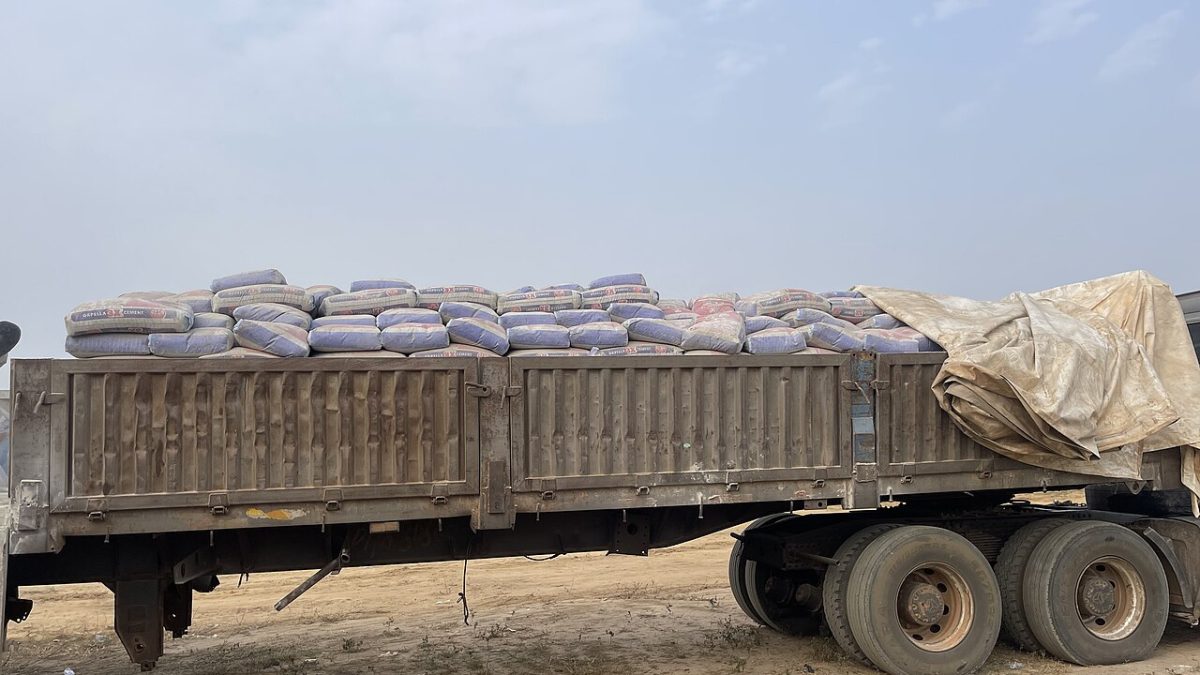
Quick answer: A standard 3-bedroom bungalow in Nigeria (roughly 100–130 sqm) needs approximately 350–550 bags of cement in total, covering the foundation, block work mortar, floor slab, plastering, and tiling screed. The exact number depends on your soil type, foundation design, floor area, and whether your design includes a suspended (German) floor slab. A 3-bedroom flat in a duplex or storey building typically needs more cement because of the suspended floor slab and ring beams at each level.
Why "How Many Bags of Cement" Does Not Have One Fixed Answer
Cement consumption depends on far more than bedroom count. Two "3-bedroom houses" can use very different amounts of cement depending on:
- Foundation type — a strip foundation on firm soil uses far less cement than a raft foundation on soft or waterlogged soil
- Floor plan area — a compact 100 sqm layout uses noticeably less than a spacious 160 sqm layout with the same bedroom count
- Floor system — a suspended (German) floor slab on blockwork adds significantly more cement than a simple ground-bearing slab
- Finish level — thicker plaster coats, screeded floors before tiling, and rendered external walls all add to the total
The breakdown below uses a typical 3-bedroom bungalow of about 120 sqm on reasonably firm soil as the baseline, with notes on what increases or decreases the figure.
Stage-by-Stage Cement Breakdown
1. Foundation: 40–90 bags
Covers blinding concrete under the footing, the foundation footing/trench-fill concrete, and mortar for foundation block work up to damp-proof course (DPC) level. Firm laterite soil with a standard strip foundation sits at the lower end (40–55 bags); soft or waterlogged soil requiring a raft foundation can push this to 70–90 bags.
2. Block Work Mortar (Walls): 70–110 bags
A 3-bedroom bungalow typically uses 2,800–4,200 nine-inch sandcrete blocks for external and internal walls combined. At a standard 1:6 mortar mix, this requires roughly 70–110 bags of cement for laying mortar alone — not counting the cement used to manufacture the blocks themselves if you are moulding them on-site.
3. Floor Slab: 60–180 bags
This is the single biggest source of variation. A simple ground-bearing slab (cast directly on compacted hardcore and blinding) for a 120 sqm bungalow uses approximately 60–90 bags. A suspended German floor slab — common where the ground floor is raised above a crawl space, or in any storey building — uses substantially more concrete and can require 130–180 bags for the same floor area, because the slab itself, plus supporting block work below it, both consume cement.
4. Columns, Ring Beam and Lintels: 30–60 bags
Reinforced concrete columns at corners and openings, the ring beam tying the wall top together, and lintels over doors and windows together typically use 30–60 bags for a single-storey 3-bedroom design.
5. Plastering (Internal and External): 70–110 bags
A 3-bedroom bungalow has roughly 250–320 sqm of internal wall surface and 180–230 sqm of external wall surface to plaster. At standard plaster thickness (12–15mm) and a 1:6 mix, this uses approximately 70–110 bags across both internal and external surfaces.
6. Floor Screed Before Tiling: 25–45 bags
A bonding/levelling screed laid before floor tiles are fixed typically adds 25–45 bags for a 100–130 sqm floor area, depending on screed thickness and whether all rooms are tiled or some are left as bare concrete (e.g. store rooms).
Total Cement Estimate by Foundation and Floor Type
| Configuration | Total Bags (Approx.) |
|---|---|
| Strip foundation + ground-bearing slab (firm soil) | 350–430 bags |
| Strip foundation + suspended floor slab | 420–500 bags |
| Raft foundation + suspended floor slab (soft/waterlogged soil) | 460–550+ bags |
These totals cover foundation through plastering and floor screed — the core structural and finishing-prep cement usage. They exclude cement used in ancillary items such as a fence wall, septic tank, or external paving, which should be budgeted separately.
Quick Formula to Estimate Cement for Your Own House
If your house differs significantly in size from the 100–130 sqm baseline above, scale the figures roughly in proportion to floor area: a 160 sqm 4-bedroom design will typically use 25–35% more cement than a 120 sqm 3-bedroom design across foundation, block work, slab, and plastering combined. For an exact figure tailored to your specific floor plan, soil type, and location, use a proper itemised estimator rather than scaling rule-of-thumb numbers — soil conditions in particular can shift the foundation cement requirement by 50% or more.
2026 Cement Prices in Nigeria
As of 2026, a 50kg bag of cement costs approximately ₦11,500–₦13,500 depending on brand (Dangote, BUA, Lafarge) and your location, with prices typically higher in inland and northern states due to transport costs from manufacturing plants. At an average of ₦12,500 per bag, the total cement bill for a standard 3-bedroom bungalow (400 bags) comes to approximately ₦5 million — making cement one of the largest single material line items in any Nigerian building budget, alongside blocks, roofing, and tiles.
Get an Exact Figure for Your Project
Rule-of-thumb bag counts are useful for early budgeting, but they cannot account for your exact floor plan, wall lengths, soil report, or finish specification. The Nigeria Building Cost Estimator calculates your actual cement requirement — and every other material — as part of a full itemised Bill of Quantities, based on your specific building type, location, floors, and soil type.
Are You Ready to Estimate Your Building Cost in Nigeria?
Stop guessing and start building with confidence. Our free Nigeria Building Cost Estimator generates an accurate, itemised Bill of Quantities in minutes — tailored to your location, house type, and finish level.
Start Your Free Estimate →